Are Tall Sizes Just Longer? What Actually Changes vs Regular
This article contains affiliate links. If you buy through them, The Tall Take may earn a commission at no extra cost to you. As an Amazon Associate I earn from qualifying purchases. Full disclosure.
Disclosure: As an Amazon Associate I earn from qualifying purchases. Some links in this post are affiliate links (paid links), which means I may earn a commission at no extra cost to you. I only recommend things I would actually tell a friend to buy.
Most men’s clothing labelled “tall” is doing one thing: adding length.
That sounds like it should be enough. It isn’t — and it’s why you can order the tall version of a shirt, put it on, and still feel like something’s off without being able to name what.
Length is only one of four measurements
When a brand makes a “tall” version, the cheap way to do it is to take the standard pattern and extend it. Longer sleeve, longer body, longer inseam. Done.
The problem is that a taller frame isn’t a standard frame stretched vertically. It’s a different set of proportions:
- The rise — crotch to waistband — needs depth, or the trousers sit wrong and pull.
- The chest and shoulder sit at different points on a longer torso.
- The sleeve-to-shoulder ratio changes. A longer sleeve on a standard armhole still binds.
- The inseam is the only one most brands actually adjust.
Get one right out of four and the garment technically “fits” while looking subtly wrong. That’s the gap you’ve been feeling.
The three checks, in order
Do these in sequence. The first failure tells you to stop.
1. The shoulder seam
The shoulder seam should sit right on the outer edge of your shoulder — the bony point — not partway down your upper arm and not up on top.
This is first because it’s the one thing you can’t fix. A tailor can shorten sleeves and hem trousers all day. Re-cutting a shoulder is expensive enough that it’s rarely worth it on anything but a jacket you love.
2. The sleeve break
The cuff should end at your wrist bone — that knob on the outside of your wrist. Not before it. Not swallowing your hand.
To measure: from the centre back of your neck, across the shoulder and down to the wrist bone with a slight bend in the elbow. Most brands that publish a sleeve measurement are measuring this. If they don’t publish it, that tells you how seriously they take tall sizing.
3. Rise depth
This is the one nobody checks and everybody feels.
If the rise is too shallow, the trousers pull at the crotch, the waistband sits low at the back, and the whole leg line is thrown off no matter how long the inseam is. You’ll assume the jeans are “just uncomfortable.” They’re the wrong rise.
Look for a published rise measurement. Roughly 11 inches or more on a straight or relaxed fit is a reasonable starting point for a taller frame, though it varies with how much of your height sits in your torso versus your legs.
The red flag on any size chart
If a brand’s “tall” range offers exactly one extra inseam number and nothing else changes, it’s a length-only fit.
That’s the tell. A brand doing real tall sizing publishes adjusted rise, sleeve and body length — not just a 34″ option next to the 32″. It doesn’t make the garment unwearable. It means you should check items 1 and 3 carefully and expect the fit to be compromised somewhere.
Where this leaves you
Specialist tall brands
Companies that only make tall clothing adjust proportions properly, because it’s the entire point of the business. American Tall designs for roughly 6’0″–7’1″ and adjusts rise and leg rather than just extending length, with 36″, 38″ and 40″ inseams. 2Tall targets 6’3″–7’4″ and also cuts excess width, which matters if you’re tall and lean rather than tall and broad. Todd Shelton goes to a 38″ inseam in one-inch increments.
These are direct-to-consumer. Best fit, narrower selection, usually higher prices.
Mainstream brands with genuine long inseams
The practical everyday option. Several mainstream labels carry 36″ inseams on at least some styles, generally under $100 — Levi’s, Lee and L.L.Bean are the reliable names.
The trick is searching by measurement rather than by the word “tall.” Search the inseam number directly — “36 inseam men’s jeans”, “38 inch inseam” — because that surfaces what actually exists instead of what marketing has labelled tall.
[ADD AMAZON AFFILIATE LINKS HERE] — suggested picks, all commonly stocked in 36″+ inseam: Levi’s 541 Athletic Taper (https://amzn.to/4gfnDko) or 505 Regular (https://amzn.to/4wq3Api); Lee Extreme Motion (https://amzn.to/4cHSeWD) ; L.L.Bean Standard Fit; plus one relaxed or wide-leg option to match the current 2026 silhouette. Format each as: brand + fit name + why it works for a tall frame + (paid link).
The short version
- Shoulder seam first — the one thing you can’t fix later.
- Sleeve to the wrist bone — not before, not past.
- Rise depth — the fit problem you’ve been blaming on the wrong thing.
- One extra inseam number is not a tall fit. It’s a length-only fit wearing a tall label.
Measure once, write your numbers down, and buy against them instead of against a label.
Know your height but not your numbers? Comment with your height and I’ll tell you which of the three to check first.
Read next: why sizing up never buys you length and the long coat trend and how to buy the length.
What to actually buy
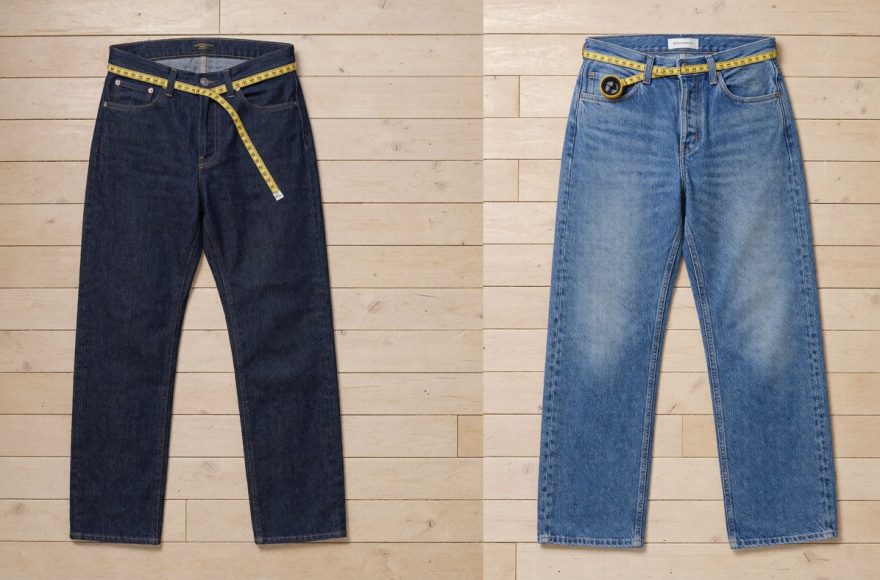
Here is what these checks look like applied to things I actually own.
Everything I currently think is worth buying, plus what I bought and sent back, is on Tall Deals.
The Tall Take newsletter
Get the list
Tall gear that is actually worth buying — measured by hand at 6 foot 8, and the stuff I sent back. No fluff, no full-price nonsense.


8 comments