Rise vs Inseam on Jeans: What Each One Measures
This article contains affiliate links. If you buy through them, The Tall Take may earn a commission at no extra cost to you. As an Amazon Associate I earn from qualifying purchases. Full disclosure.
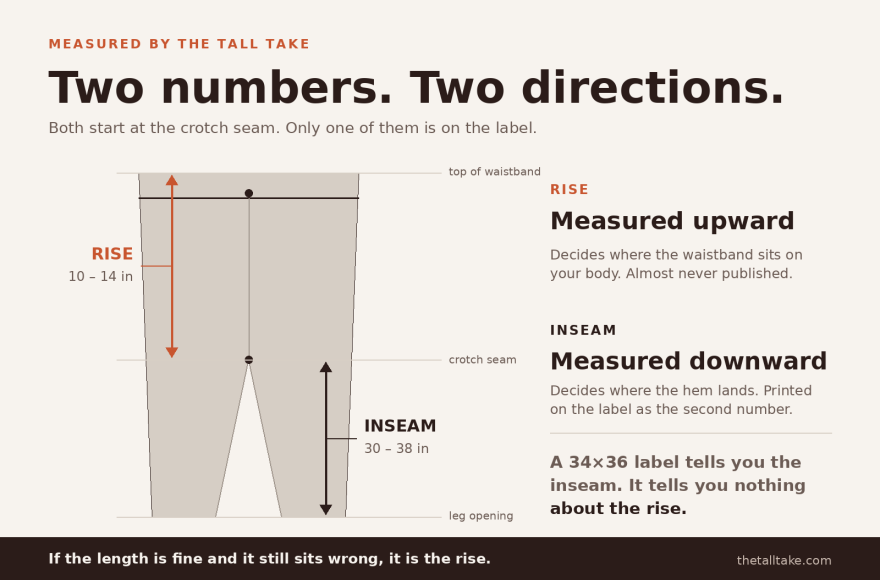
Inseam is the length of the leg. Rise is the height of the waistband above the crotch seam. They are measured in different directions and they solve different problems, and confusing them is the most expensive mistake a tall man makes buying jeans.
Inseam moves the hem. Rise moves the waistband. If your jeans are long enough but still sit wrong, you have an inseam that works and a rise that does not — and no amount of extra inseam will fix it.
Where each one is measured
| Inseam | Rise | |
|---|---|---|
| Measured from | Crotch seam | Crotch seam |
| Measured to | Bottom of the leg opening | Top of the waistband |
| Direction | Down the inside of the leg | Up the front (or the back) |
| Typical figure | 30–38 inches | 10–14 inches |
| What it decides | Where the hem lands | Where the waistband sits on your body |
| On the label? | Usually, as the second number | Almost never |
A pair of 34×36 jeans tells you the waist is 34 and the inseam is 36. It tells you nothing at all about the rise, which is the measurement that decides whether the waistband lands on your hips, your navel or somewhere in between.
Front rise and back rise are two different numbers
When a listing does publish a rise, it usually means front rise — crotch seam up to the top of the waistband at the front. Back rise is the same measurement taken up the seat, and it is always the larger of the two.
The gap between them is what stops the waistband sliding down at the back when you sit. On a pair of shorts I measured, the front rise was 12 inches and the back rise 15.5 — a three and a half inch split. On another pair it was 12.5 and 17, a four and a half inch split. Neither number appeared on either label.
The rise chart, and what each band actually means
| Rise category | Approximate front rise | Where the waistband sits |
|---|---|---|
| Low rise | about 10 inches | On the hip bones, below the navel |
| Mid rise | about 11 inches | Between hip and navel |
| High rise | about 12 inches | At or just below the navel |
Here is the part the chart does not tell you: those bands are calibrated to a body that is not yours. A 12 inch front rise is called high rise because on a 5′10″ frame it reaches the navel. On a longer torso the same 12 inches lands considerably lower, which is why tall men so often find that even the high rise option sits like a mid rise.
Why the inseam is not your problem
Adding inseam lowers the hem. It does not raise the waistband, and it does not add a single inch of torso coverage. If your jeans reach your shoes but the waistband sits below where you want it, buying a longer inseam changes nothing about the complaint you actually have.
Two signs it is the rise and not the inseam: the waistband drifts down through the day and needs pulling up, or you can see a gap of shirt between the top of the jeans and the bottom of a jumper when you raise your arms. Both are rise problems. Neither improves with a longer leg.
Definitions only take you so far. I measured five pairs at 6′8″, every front rise taken flat by hand and normalised to a 36 inch inseam so they compare fairly. The worst offender published a front rise of 11 and seven eighths inches and measured 14.5 — that is not a rounding error.
The five pairs, the numbers, and the two I kept: Men’s Front Rise Chart →
How to find your own number in five minutes
- Take the pair of trousers you own that sits best. Not the newest, the one you reach for.
- Lay them flat, front up, and smooth the front panel without stretching it.
- Measure from the crotch seam straight up to the top of the waistband. That is your front rise.
- Write it down. That single number will sort more listings for you than any size label.
Then, when a listing does publish a rise, you know immediately whether it is worth ordering. When it does not — which is most of the time — you know what to ask.
Tall inseam versus regular inseam
A tall size adds inseam. Some tall patterns add a little rise as well, but the length is the headline and the rise is rarely stated, so you cannot assume it. That is the same trap in a different coat: sizing up is not the same as sizing tall, and neither one guarantees you the rise you need.
If what you are actually trying to work out is what height a given inseam suits, that is a different question with a different answer — what height is a 36 inch inseam covers it.
The short version
- Inseam = crotch seam to hem. Decides where the trouser ends.
- Rise = crotch seam to waistband. Decides where the trouser starts.
- Labels publish inseam. They almost never publish rise.
- Low / mid / high rise means roughly 10 / 11 / 12 inches at the front, calibrated to an average torso.
- Back rise is always larger than front rise. The gap is what keeps the waistband up when you sit.
- If the length is fine and it still sits wrong, it is the rise.
The full argument, with what to do about it, is in the front rise chart, five pairs measured.




3 comments