How Long Should a Coat Be on a Tall Man? Back Length, Measured at 6′8″
This article contains affiliate links. If you buy through them, The Tall Take may earn a commission at no extra cost to you. As an Amazon Associate I earn from qualifying purchases. Full disclosure.
Most menswear trends are a tax on being tall. Cropped jackets, boxy tees, short-rise trousers, anything described as a “shrunken fit” — you pay for them in exposed wrists and a hem that will not stay put. This season is the exception.
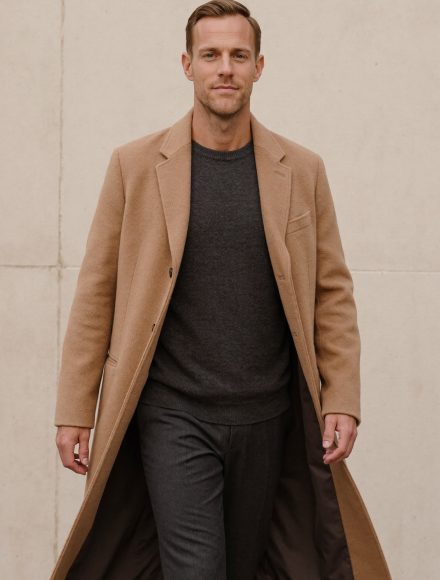
The long overcoat is the lead outerwear silhouette going into fall, and it is one of the very few trends that actually needs the frame you already have. A coat that finishes at or below the knee requires an uninterrupted vertical line to carry it. On an average frame it swamps the wearer and reads as borrowed. On a long frame it just reads as deliberate.
There is one catch, and it is a sizing catch rather than a styling one. I measured my own body and six coats to put a number on it, and the number is worse than I expected.
Why the long coat favours a long frame
A knee-length coat is a single unbroken block of colour running from shoulder to knee. That is exactly the kind of line that flatters height and exactly the kind of line that overwhelms someone who does not have much of it. The garment does not shorten a tall man the way a cropped jacket does; it uses the length instead of fighting it.
It also solves a problem tall men have every autumn. A standard jacket that stops at the hip on an average frame stops closer to the waist on a long torso, which is how a perfectly good coat ends up looking outgrown. Going longer removes that failure mode entirely, because the hem is nowhere near the danger zone.
The trap: “Long” is not the same as “Tall”
Tailored outerwear is usually sold as a chest measurement plus a length letter — 42R, 42L, and so on. The natural assumption is that the L is the tall size. It is not, or at least not in the way a tall shirt is.
Across most tailoring lines, moving from Regular to Long adds roughly one to one and a half inches of body length and a comparable amount of sleeve. One published overcoat chart specifies the difference as about two centimetres, which is under an inch. That is the entire upgrade.
Now look at who that single length is sold to. On that same chart, a 42L is specified for men from six feet to six foot three. A 46L covers six foot one to six foot four. A 48L covers six foot two to six foot four. One length is being asked to serve a spread of three or four inches of height, and an inch of extra body does not cover it. The men at the top of each range are wearing a coat drafted for the men at the bottom.
This is the same trap as sizing up a shirt, in a different costume. Standard grading adds about two inches of chest per size but only around half an inch of body length, which is why going up a size never buys you the length you were actually after.
The number that matters is back length — here is what each one actually does
Stop shopping the letter and start shopping the measurement. Nearly every size chart worth trusting publishes a centre-back or body length in inches, measured from the base of the collar seam straight down to the hem. That number, not the R or the L, tells you where the coat will finish.
The problem with every guide that says this, including the earlier version of this one, is that it then tells you a coat should land two to three inches below the knee and leaves you there. That is a relative instruction. Nobody knows where his knee falls on a coat he has not bought yet.
So I measured myself. At 6′8″, standing barefoot: the base of my neck at the back is 68 inches off the floor, my belt line is 44, the bottom of my seat is 36, and the top of my knee is 24. Which makes two to three inches below the knee a spot roughly 21 to 22 inches off the floor — a real place, with a number on it.
Then I wore four coats and wrote down where each one finished.
| Coat | Back length | Where the hem landed |
|---|---|---|
| BGOWATU quilted bomber, XXL | 30 | belt line |
| Wantdo puffer, 2XLT | 31 | mid-seat |
| Legendary Whitetails waxed, 2XT | 33.25 (net of a 3.25 in collar) | mid-seat |
| Amazon Essentials mid-length puffer, XXL Big & Tall | 35 | bottom of the seat |
Five inches of extra back length moved the hem eight inches down my body, in order, with no exceptions. And the longest coat any of these brands sold me as big-and-tall stopped at the bottom of my seat — nowhere near my knee, let alone below it.

A flat measurement is not a distance on your body
Here is the part no size chart mentions, and it is the reason careful arithmetic still ends in a coat that is too short.
A garment measured flat follows its own surface. Worn, some of that length is spent travelling over your shoulder blades and the curve of your back before the hem starts descending at all. Across those four coats, the flat back length overstated the actual drop by three to six inches, averaging about four. A coat listed at 35 inches down the back gave me about 31 inches of reach.
I checked that against a completely different garment and got the same answer. Working from front rise on five pairs of jeans — different part of the body, different measurement, different category — the gap came out at four inches almost exactly. Every flat figure you read quietly overstates its reach, and it is worth about four inches.
What a published overcoat length actually does on a 6′8″ frame
Published overcoat back lengths run from roughly 37 to 42 inches. Run those through the same arithmetic — 68 inches at the neck, about four inches lost between the tape and the body — and this is where they finish on me.
| Published back length | Lands, inches off the floor | On me that is |
|---|---|---|
| 37 | 35 | bottom of the seat |
| 40 | 32 | upper thigh |
| 42 (the long end of a normal chart) | 30 | upper thigh |
| 46 | 26 | just above the knee |
| 50 | 22 | below the knee |
The entire published overcoat range lands between my seat and my mid-thigh. None of it reaches my knee. To get the silhouette every guide describes, I would need a back length of around 50 inches. The longest coat I was sold as big-and-tall measured 35.
Sanity check, because a number that large deserves one: a knee-length topcoat on a five foot ten man runs about 40 to 42 inches down the back. Scale that to my height and you land at 46 to 48 inches — the same neighbourhood, reached from the opposite direction.
The earlier version of this page said a forty-inch back length puts the hem at the knee. That is true on a six foot three frame. On mine it lands at the upper thigh, eight inches high. If you are six foot five or more, the tall end of a normal chart is not where you should be looking. It is where the coat still ends up too short.
Will it close over a sweater? Use your chest, plus ten
Length is what this page is about, but it is not what sends a coat back. The question that actually decides a winter coat is whether it shuts over a jumper in February, and no guide puts a number on that either.
My bare chest is 51 inches. Here is what happened.
| Coat chest, around | Room over my chest | Closed over a sweater? |
|---|---|---|
| 56 | 5 in | no |
| 57 | 6 in | no |
| 62 | 11 in | only just |
| 70 | 19 in | yes, and it was bulky with it |
Ten inches of room over your bare chest is the floor, and ten is uncomfortable. Five or six is not close. Fifteen is where it becomes pleasant. Measure your chest, add ten, and do not order a coat whose chest figure is below that number.
One caveat that matters more than it looks. My chest is wider than my midsection, so for me the chest figure is the binding one. If your waist is bigger than your chest — common enough — apply the same ten inches to that measurement instead. A coat that closes across the chest and not across the stomach is still a coat that does not close.
Sleeves, shoulders and hoods — the three checks after length
Sleeve. A coat sleeve is worn over other sleeves, so it should cover the wrist bone completely with your arms down. Measured from the base of my neck, over the shoulder and down the outside of a relaxed arm, I am 35 inches. The four coats ran 37.5 to 41 inches centre-back to cuff, and all of them covered the wrist. Roughly three to six inches more than your own neck-to-wrist figure is what a coat sleeve needs. A coat sleeve that ends where a shirt sleeve would is short.
Shoulder. This is the one nobody can fix afterwards. Two Nautica coats I owned had identical 58-inch chests and opposite problems: the sailing jacket had a 20-inch shoulder and was far too small, the pea coat had 25 and was far too big. Length sorted neither of them. All four of the new coats measured 22 to 24 and all four cleared that problem, which is why they went back for other reasons. The full working-out is in five layers measured at 6′8″, two kept.
Hood. Nobody publishes hood openings, so I measured them: 12, 13 and 17 inches across three hooded coats. My head is 23.25 inches around. All three went over it easily, and all three stayed up with the zip closed — including the 12. I expected the small one to fail and it did not. That is one fewer thing to worry about.
How to check before you buy
- Measure your own two numbers once. Floor to the base of your neck at the back, and floor to the top of your knee. They take a minute, they never change, and they turn every size chart into a prediction instead of a guess.
- Subtract about four inches from any published back length before you decide where it lands. That is the gap between a flat tape and a worn garment.
- Do the subtraction from your neck height. Neck height minus (back length minus four) is roughly where the hem finishes, in inches off the floor. Compare that to your knee.
- Measure your chest and add ten. Do not order a coat below that figure if you plan to wear anything under it.
- Check the sleeve separately — centre-back to cuff, three to six inches more than your own neck-to-wrist.
- Check the shoulder last, and treat it as a hard limit. It is the only measurement a tailor cannot rescue.
- If the listing publishes no back length at all, treat that as information about the listing rather than an obstacle to overcome.
This does not have to be expensive
None of the above is a budget problem. It is a specification problem. A fifty-inch back length costs exactly what a thirty-seven-inch back length costs. What you are paying for is a pattern drafted for your proportions, and that is a choice the brand made before the coat was ever priced.
Every figure on this page came off a tape in my own hands, and every garment was one I bought and wore. If you want the raw numbers for the coats, sweaters and everything else I have measured, they are in the tall sizing database.
The trend is genuinely on your side this season. Just do not let a letter on a label decide how long your coat is — and do not trust the chart until you have taken four inches off it.
The Tall Take suggestions
Wool Pea Coat
Price changes often — check the current price on Amazon. As an Amazon Associate I earn from qualifying purchases.
The Tall Take suggestions
Long Dress Coat
Price changes often — check the current price on Amazon. As an Amazon Associate I earn from qualifying purchases.
What to actually buy
I have not owned and measured a tall overcoat yet, so I am not going to recommend one.
Everything I currently think is worth buying, plus what I bought and sent back, is on Tall Deals.
The Tall Take newsletter
Get the list
Tall gear that is actually worth buying — measured by hand at 6 foot 8, and the stuff I sent back. No fluff, no full-price nonsense.



4 comments