Men’s Front Rise Chart: Five Pairs of Tall Jeans, Measured
This article contains affiliate links. If you buy through them, The Tall Take may earn a commission at no extra cost to you. As an Amazon Associate I earn from qualifying purchases. Full disclosure.
You did the obvious thing. You found jeans in a 36 inseam, ordered them, and they still look wrong. The hem is fine. The length is fine. Something else is off and it is hard to name.
It is the rise, and almost nobody talks about it.
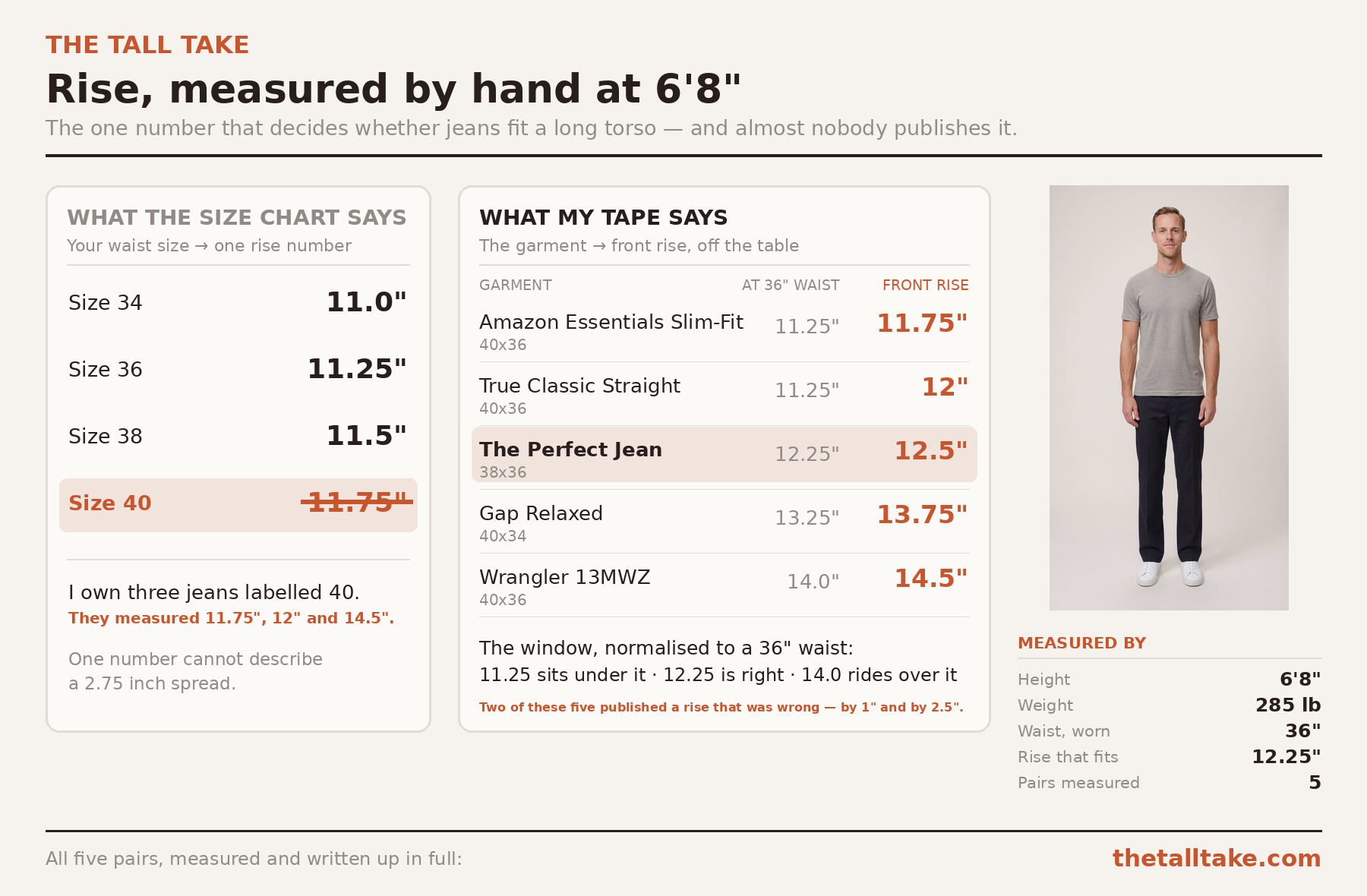
That is the problem in one picture. The rest of this page is how to use it: what rise is, how to find the number that fits you, and which of those five pairs I kept.
What rise actually is
Rise is the distance from the top of the waistband straight down to the crotch seam. Every pair of jeans has a front rise and a back rise. It is the measurement that decides how high the jeans can sit on you and how much room you get through the crotch — and unlike inseam, it is usually invisible on the product page.
If you are here to sort out the two terms rather than solve a fit problem, start with rise vs inseam: what each one measures. And if the question is really which inseam suits your height, that is what height is a 36 inch inseam.
Low, mid and high rise mean roughly 10, 11 and 12 inches at the front. Those bands, and why they are calibrated to a body that is not yours, are set out in rise vs inseam: what each one measures. This page is the measured version — what the tape actually said.
Every front rise on this page, plus the chinos and joggers measured the same way, is in The Tall Sizing Database.
Where the waistband sits changes your proportions
A longer leg cannot raise a waistband — that argument is made in full here. What matters on this page is what happens next.
When the rise is short for your torso the waistband settles on your hips, the crotch seam follows it down, and the visual cost is the opposite of what you want. The waistband is where the eye reads the break between torso and leg. Drop it two inches and your torso reads longer and your legs read shorter, which is precisely the proportion a tall frame should be exploiting rather than giving away. The same logic that governs where a colour break falls applies to where your waistband sits.
Two signs you need more rise
- You cannot pull them up far enough. They stop somewhere on your hips and no amount of hitching fixes it.
- The crotch is tight when you do pull them up. You can get them to your waist, but only by wearing them uncomfortably.
Either one means the rise is short for your torso. The opposite failure exists too — too much rise and the jean sags below the crotch with a visible pocket of empty fabric. And a fuller seat consumes rise, so two men of the same height can need different numbers.
How to find your own target rise
You do not need a brand to tell you. You need a tape and ten minutes.
- Go through the jeans you own and find the pair that fits best through the rise — not the best-looking pair, the one that sits where you want it without pinching.
- Lay it flat, unbuttoned, front facing up.
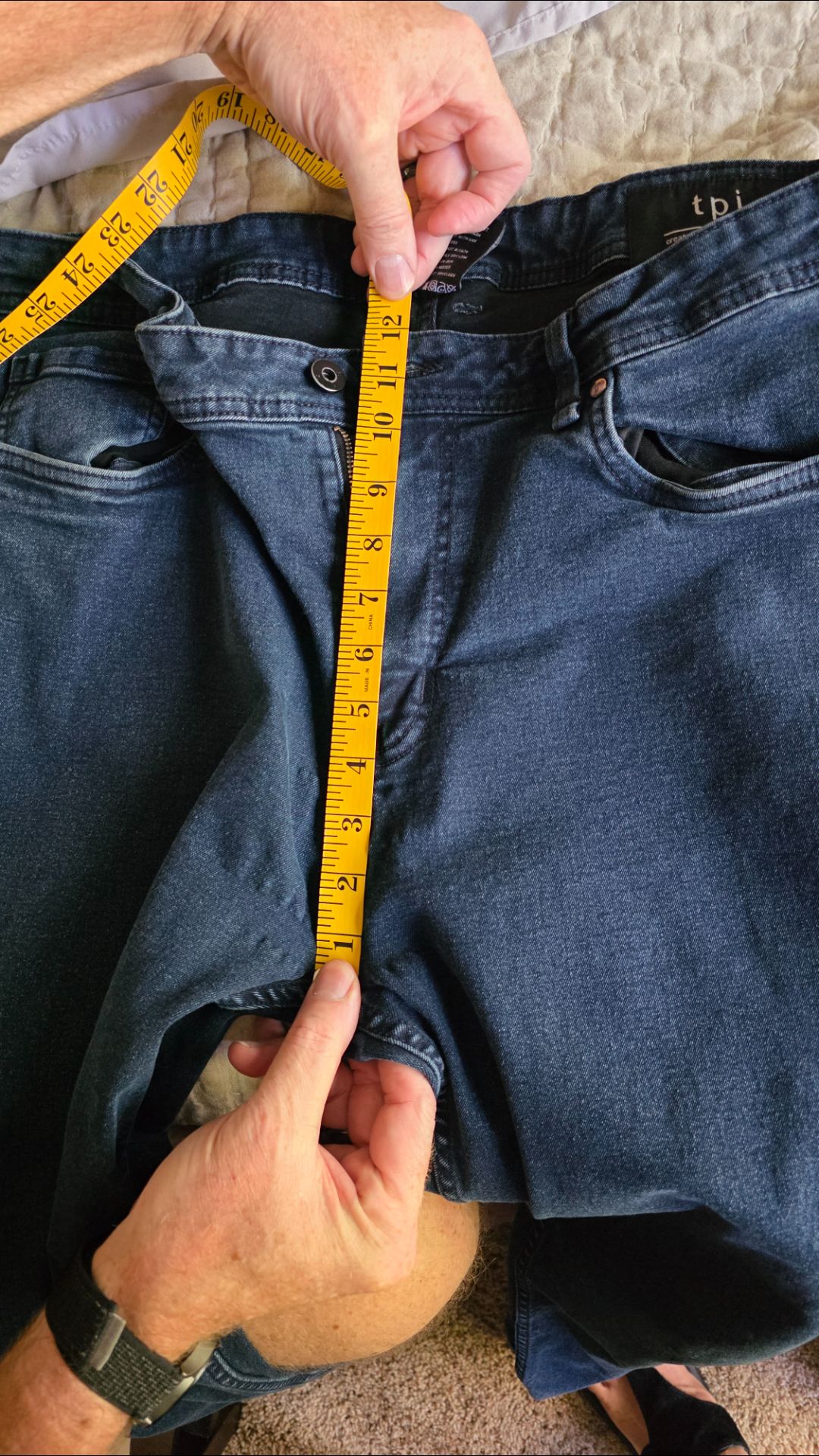
- Measure from the top edge of the waistband straight down to the crotch seam. That is your front rise.
- Write the number down. That is your baseline.
- If that pair sits right but is slightly tight in the crotch, add half an inch. If it is well short of your waist, add a full inch or more.
Now you have a number to shop against instead of a vague sense that something is wrong. This is the same approach that works for jogger inseam, where the published number also fails to mean what you assume.
The problem: most brands will not tell you
This is the genuinely annoying part. Inseam is printed everywhere. Rise is published by almost nobody. Todd Shelton’s denim blog researched over forty brands to compile a list of makers publishing a front rise of 11.5 inches or more, and could only verify ten — not because the others do not make high-rise jeans, but because they do not publish the specification at all.
A few things worth knowing when you do find a size chart with rise on it:
- Rise scales with waist size, roughly an eighth of an inch per size. A brand quoting 11 inches at a 32 is around 11.5 inches at a 36. Levi’s publishes for a size 32 only, so you do that arithmetic yourself.
- Relaxed fits carry more rise than slim fits. If you default to slim because you are tall and lean, you are compounding the problem.
- Back rise stretches about an inch during wear and returns after washing. Do not re-measure a pair you have had on all day and conclude the spec was wrong.
Where the tall market specifically fails is simpler than any of that: tall lines add inseam and leave the rise alone. You get the extra length and none of the extra torso, which is why a 36 inseam on a tall-specific jean can still sit wrong on a long body. The broader point about tall sizing being a different pattern rather than a bigger one is covered in why sizing up never buys you length.
I measured four pairs. Two of them went back.
Everything above was written from published specifications. Then I put a tape on four pairs at 6 foot 8, and two of my own recommendations fell apart.
Rise scales with waist size, so raw numbers are not comparable across sizes. Everything below is normalised to a size 36 at one eighth of an inch per size.
| Jean | Size measured | Front rise | Normalised to 36 | What happened |
|---|---|---|---|---|
| Amazon Essentials Slim-Fit | 40 | 11.75 in | 11.25 in | Under. Bought twice |
| The Perfect Jeans | 38 | 12.5 in | 12.25 in | Right. Bought twice |
| Gap Relaxed Fit | 40 | 13.75 in | 13.25 in | Over. Returned |
| Wrangler 13MWZ | 40 | 14.5 in | 14.0 in | Over. Returned unworn |
Two published figures were wrong. Wrangler lists up to 11 7/8 inches; it measured 14.5. Gap lists 12 3/4; it measured 13.75. Both were off in the same direction, and I had recommended both of them on the strength of those numbers — in an article about not trusting those numbers. That is worth saying plainly rather than quietly editing out.
Too much rise is worse than too little
This is the finding I did not expect, and it only shows up if you wear the things rather than measure them.
The pair that sits a full inch under my window gets worn constantly and I have bought it twice. Both pairs that ran over went back — one of them without ever being worn outside the house. The failure is not symmetrical.
So if you are unsure, err low. Everyone’s instinct is to reach for more rise once they understand the problem. Mine was too, twice, in the same week. That instinct is wrong.
High rise assumes a flat stomach
The Gap pair is drafted to sit at the navel. If you do not have a flat stomach it lands below the button and looks wrong — not merely lower, but wrong, because the garment is cut around an assumption about body shape rather than height alone.
Which means the number you need depends on your torso and your midsection. Two men of the same height can need different rises. No size chart will tell you that.
The cut decides the shape, not the rise
Rise and leg width broadly move together — but not in lockstep, and the exception is the useful part.
| Jean | Cut | Front rise | Leg opening |
|---|---|---|---|
| Amazon Essentials | Slim | 11.75 | 14.5 |
| The Perfect Jeans | Straight | 12.5 | 16 |
| Wrangler 13MWZ | Boot cut | 14.5 | 17 |
| Gap Relaxed Fit | Relaxed | 13.75 | 20 |
Order those four by rise and you get slim, straight, relaxed, boot cut. Order them by leg opening and you get slim, straight, boot cut, relaxed. The last two swap places, and the reason is the cut.
Slim is fitted the whole way down: least rise, narrowest hem. Straight sits in the middle on both. Relaxed is roomy throughout — high rise and the widest hem of the four. Boot cut is the one that breaks the pattern: it carries the most rise of any pair here at 14.5 inches, but a moderate 17 inch hem, because it stays close through the thigh and only opens from the knee down.
So the rule is not “more rise means wider legs.” It is that each cut bundles a rise with a leg shape, and you cannot separate them off the rack. A tall man who defaults to slim because he is lean is quietly choosing the least rise available. Anyone chasing rise for a long torso is pushed toward relaxed or boot cut — two very different looking jeans that happen to sit at the same end of the rise scale.
Correction, September 2026: this section previously said rise and leg width moved together across all four pairs without exception. That was wrong. The Wrangler is a boot cut, and it has more rise than the Gap while being three inches narrower at the hem. The numbers were always right; the pattern drawn from them was not.
What I actually recommend
Best fit — The Perfect Jeans, around $100 or lower. 12.25 inches normalised, which is my window exactly. I have bought two pairs and put 20-plus washes through them. If the rise matters more to you than the price, this is the one.
Best value — Amazon Essentials Slim-Fit Comfort Stretch, Under $25. An inch under ideal and I wear them anyway. Also bought twice. Deals can be had – they are not perfect, and at that price I will take the trade.
What I would skip. The Wrangler 13MWZ and the Gap Relaxed Fit both overshoot badly on a 6 foot 8 frame, and the Wrangler arrives stiff as cardboard. Neither is a bad jean. Both are the wrong jean for a long torso that already has enough rise problems.
Notice what money did not buy: the under $30 Wrangler has more rise than the $100 pair. Rise is not something you pay for. It is something almost nobody publishes, which is a different problem entirely.
The short version
A long inseam moves the hem. It does not move the waistband. If your jeans have the right length and still look wrong, measure the rise on your best-fitting pair, add half an inch to an inch, and shop against that number. It is the one denim measurement that changes how tall you look, and it is the one almost nobody publishes.
If none of this is landing, start further back with why tall sizing still misses.
The Tall Take suggestions
Wrangler 13mwz Cowboy Cut Jeans
Price changes often — check the current price on Amazon. As an Amazon Associate I earn from qualifying purchases.
The Tall Take suggestions
True Classic (High Stretch) (Mid Rise)
Price changes often — check the current price on Amazon. As an Amazon Associate I earn from qualifying purchases.
The Tall Take suggestions
Gap Jeans (Mid Rise)
Price changes often — check the current price on Amazon. As an Amazon Associate I earn from qualifying purchases.
The Tall Take suggestions
The Perfect Jean
Price changes often — check the current price on Amazon. As an Amazon Associate I earn from qualifying purchases.
What to actually buy
Two of the four pairs I measured are worth your money.
Everything I currently think is worth buying, plus what I bought and sent back, is on Tall Deals.
The Tall Take newsletter
Get the list
Tall gear that is actually worth buying — measured by hand at 6 foot 8, and the stuff I sent back. No fluff, no full-price nonsense.



10 comments