Compression Tights for Tall Men: Four Brands Measured at 6′8″
This article contains affiliate links. If you buy through them, The Tall Take may earn a commission at no extra cost to you. As an Amazon Associate I earn from qualifying purchases. Full disclosure.
I own four pairs of compression tights and I wear all four. Two of them cost four to five times what the other two did. Before I measured them I could have told you which pair I reached for and not told you why.
So I put a tape on all four, at 6′8″ and 285 lb, relaxed and then under a gentle pull. Three things came out of it that no listing tells you, and one of them decides whether the waistband stays where you put it. A tape cannot measure the one thing these garments exist to do, so that part is at the end, clearly marked as my judgment rather than a number.
The four, measured
| Label size | Length | Front rise | Rear rise | Waistband flat | Thigh flat | Hem opening | Waistband | |
|---|---|---|---|---|---|---|---|---|
| CompressionZ | 2XL | ¾ | 9.5 / 11 | 12 / 14 | 15 / 16.5 | 7 / 9 | 5 / 6 | 1.5 in plain band |
| SKINS | 2XL | calf | 12 / 14 | 13 / 15 | 15 / 16 | 9 / 11 | 4 / 5 | 2 in plain band |
| DFND ACTIVE | 3XL | full | 12.5 / 14 | 13 / 15 | 15 / 16 | 7 / 9 | 4 / 5 | 1.25 in band + drawcord |
| Under Armour | 3XLT | full | 8.5 / 9.75 | — | 19 / 20.5 | 10.5 / 12 | 5.25 / 6.5 | plain band |
The waistband finding, and it is the one to shop on
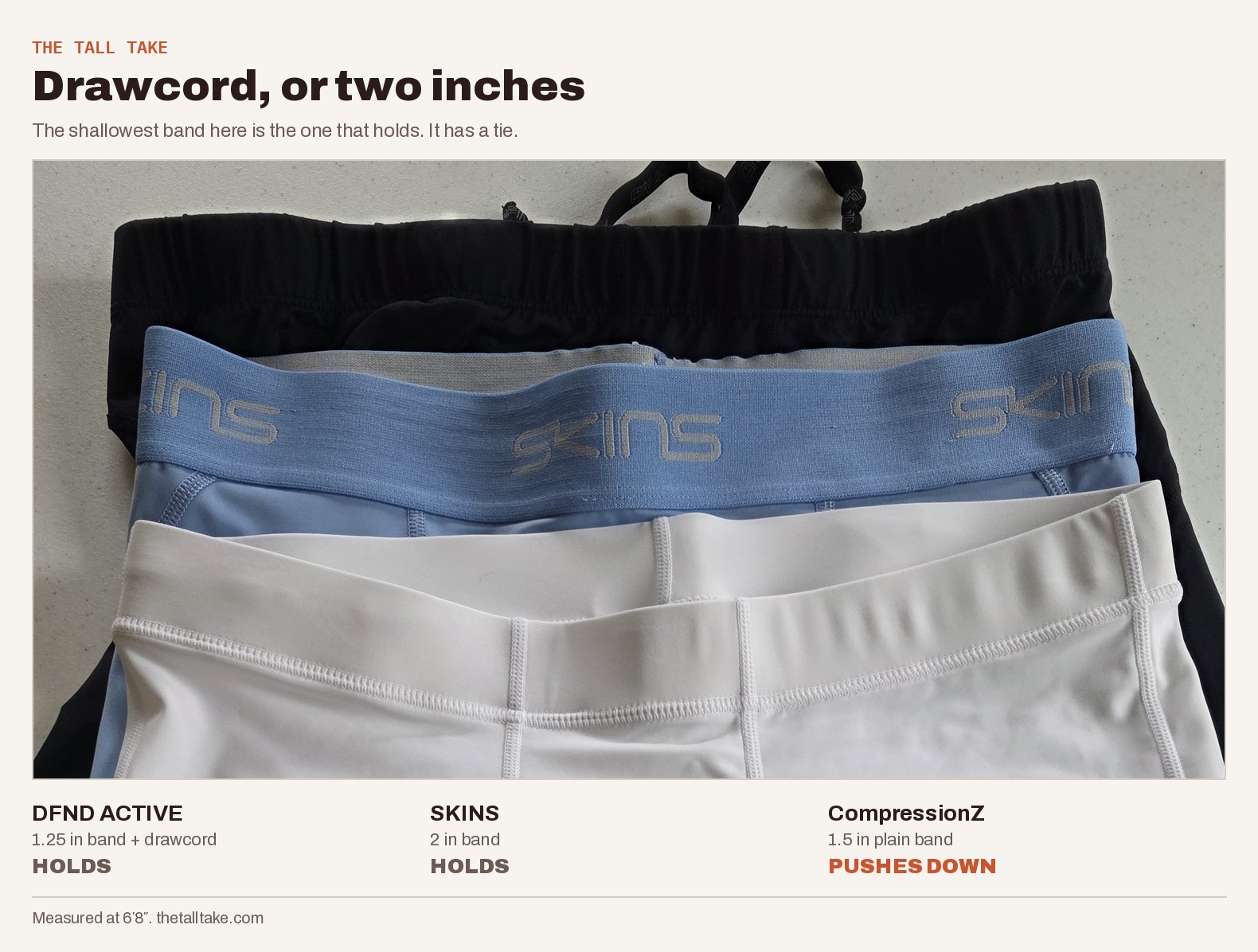
The CompressionZ pushes down through the day. The other two do not. My first guess was that the band was simply too shallow — and the numbers say that guess was wrong.
| Waistband | Stays up? | |
|---|---|---|
| CompressionZ | 1.5 in plain band | No — pushes down |
| SKINS | 2 in plain band | Yes |
| DFND ACTIVE | 1.25 in band + drawcord | Yes |
Depth alone does not predict it. The DFND has the shallowest band here and it holds, because it has a tie. There are two separate solutions to the same problem — make the band deep, or give it a draw-cord — and the pair that fails has neither.
So the rule needs no tape at all: look for a draw-cord, or a band of two inches or more. Both are visible in a listing photo before you have spent anything, and I have not seen a single product page that explains why it matters.
One qualifier I want to be honest about. Under Armour’s waistband also stays put, and it is a plain band — but I do not really class those as a compression garment. They are snug rather than compressive, so they are not asking the band to do the same job. Which is itself worth knowing: the word compression on a label does not describe one kind of garment.
Compression covers less of your back than your jeans do
Every pair of trousers has a front rise and a rear rise, and the gap between them is what keeps your back covered when you bend. Nobody publishes rear rise, so nobody thinks about it.
| Garment | Type | Front rise | Rear rise | Gap |
|---|---|---|---|---|
| DFND ACTIVE | compression | 12.5 | 13 | 0.5 |
| SKINS | compression | 12 | 13 | 1.0 |
| CompressionZ | compression | 9.5 | 12 | 2.5 |
| GM MGBOYGYM jogger | jogger | 13.25 | 16.25 | 3.0 |
| Under Armour exercise shorts | shorts | 12 | 15.5 | 3.5 |
| The Perfect Jean | jeans | 12.5 | 17.5 | 5.0 |
| Amazon Essentials jeans | jeans | 11.75 | 17.25 | 5.5 |
Compression runs a tiny gap. Denim runs a large one. That is a property of the category rather than a fault in any one pair, and it means a compression tight will not cover you at the back the way the trousers you are used to do. If you wear them to train in, that is the thing to know before you bend over.
It also explains something I felt before I measured anything. My note on the CompressionZ was the rise could be longer in the back — and it has the lowest rear rise of the three at 12 inches against 13 and 13. One inch of rear rise is the whole difference between the pair I want more from and the two I do not.
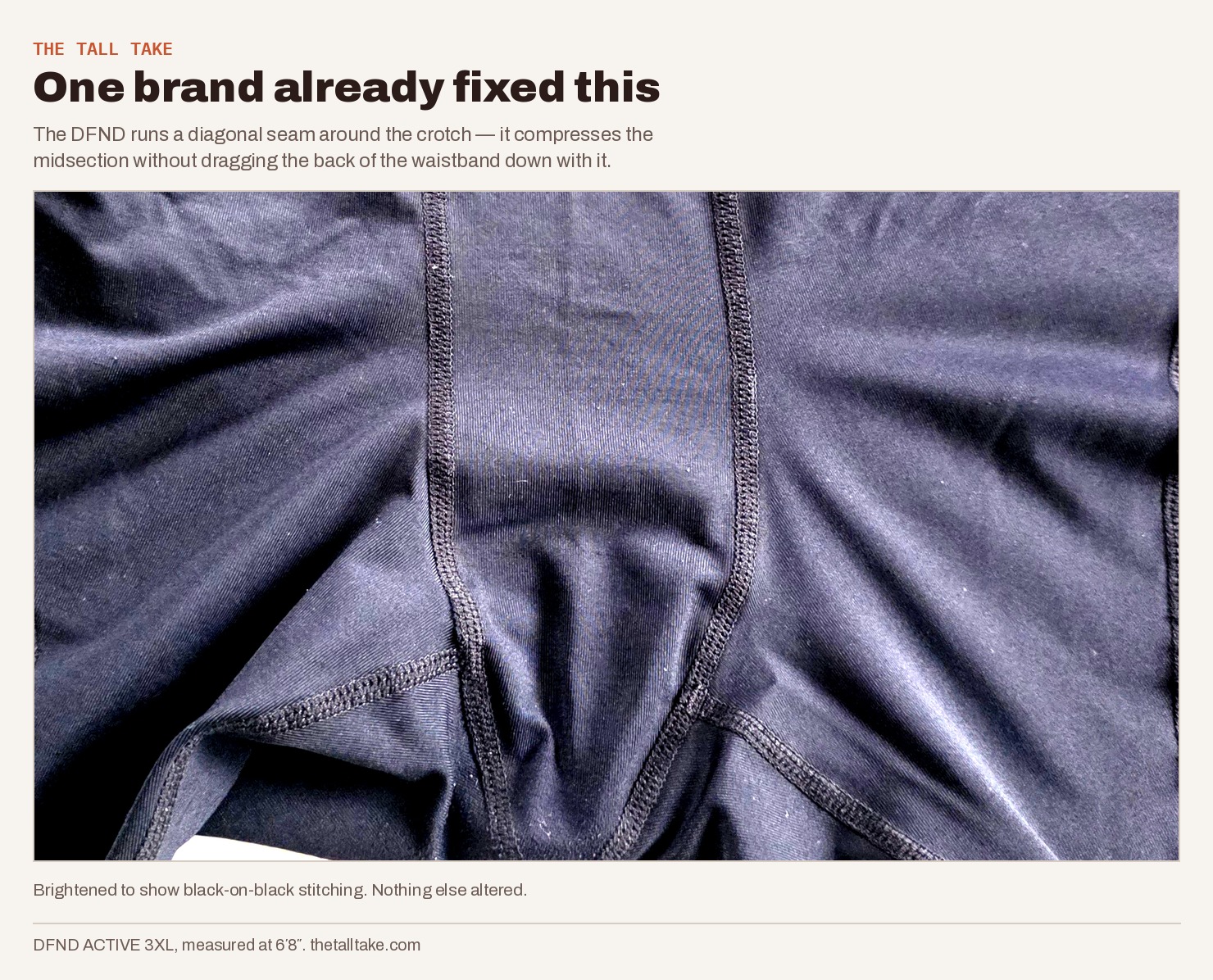
The DFND is cut differently here, and you can see it. Where the pair beside it runs one seam straight down, the DFND has a panel cut on the diagonal across the crotch. I photographed both. What I will not tell you is that the brand did that to fix the problem I have just described — that is my reading of it, not their claim. What DFND’s own material emphasises is flatlock seam placement and what they call biomechanical panelling, and a straight seam through that area is the one people complain about for chafing. Make of the coincidence what you like; it sits on the pair with the smallest front-to-rear gap in the set.
The one nobody tells you: not all of them are opaque
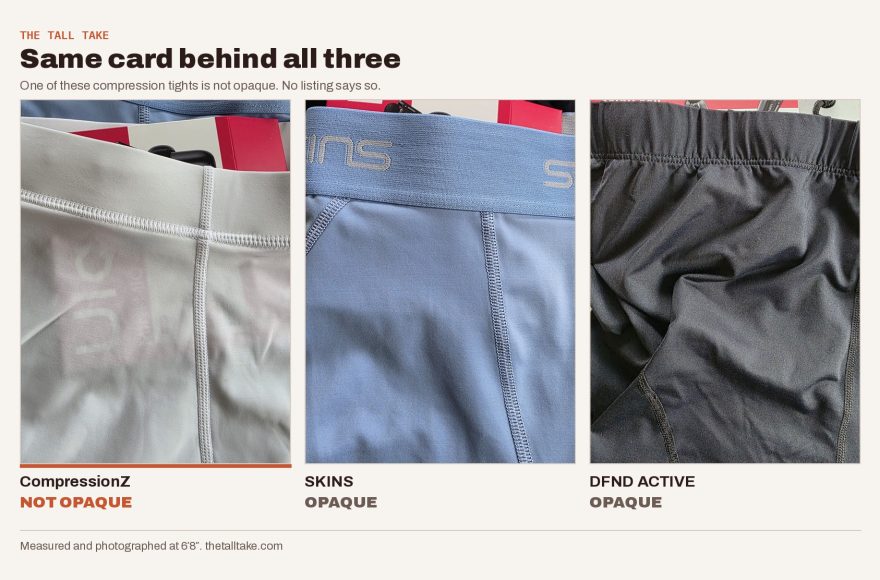
The CompressionZ is not fully opaque. The SKINS and the DFND are.
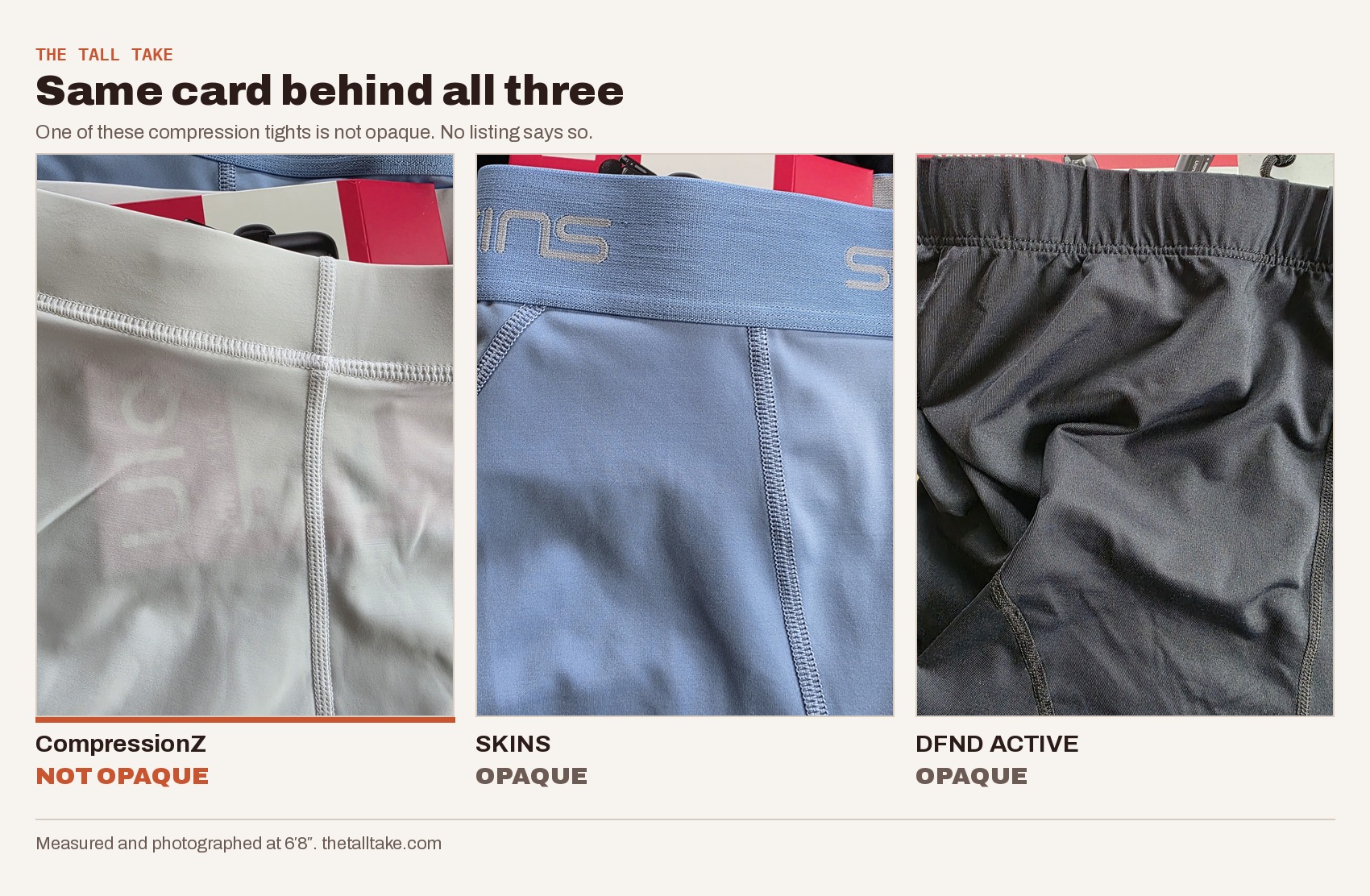
That single fact decides how you can wear them. I wear the CompressionZ under shorts, which is fine because that is how I wanted to wear them anyway — and it would not have been fine if I had planned otherwise. It is not mentioned on any listing I have read, and you cannot see it in a product photograph.
If you intend to wear compression tights on their own, this is the question to ask before the size chart. It is also the clearest thing the extra money buys.
Label size tells you very little here
Look at the waistband column again. Relaxed, all three measure 15 inches flat. A 2XL, another 2XL and a 3XL, three different brands, and the waist is the same number on all of them.
The thigh is where the size actually lives — 7, 9 and 7 — and the rises differ by two and a half inches. Three garments is not a rule, and I will test it on the next pair I buy. But it would explain why label size predicts compression fit so badly, and why two pairs marked the same size feel nothing alike.
Where the ¾ ones actually land
Nobody sells a three-quarter tight by inches. They sell it as below the knee or mid-calf, which is a relative claim drafted on a fit model who is not you.
On my leg the CompressionZ finishes at mid-calf, and the SKINS at the calf. Neither ends up anywhere near where the word knee would suggest. If you are six foot five or taller, assume a three-quarter tight will finish higher on you than the photograph shows, because the photograph is not of a long leg.
The third length, which I do not own
Everything above is a three-quarter or a full length, because that is what is in my drawer. There is a shorter one — a compression short, finishing above the knee — and it is worth knowing it exists, because a three-quarter is not the shortest thing on the market. If you only ever wear these under shorts in the gym, the short is the version you have probably been looking for.
I have not measured a pair, so what follows is a signpost and not a verdict. The 2XU Core Compression Shorts are the ones I would look at first, and the reason is one word in the listing: drawstring. That is the rule this piece already arrived at from the three pairs I did measure — a draw-cord, or a band of two inches or more — and it is visible before you spend anything.
That is the listing’s word and my reasoning, not my tape. No numbers here, no size recommendation for a long leg, and no row in the sizing database — those are for garments I have actually measured. If a pair ends up on my table it gets the same treatment as everything else and the figures go up.
Unmeasured. Listed here as a length I cannot speak to from a tape.
What a tape cannot measure
Everything above is a dimension. None of it is compression. A tape tells you how big a garment is and says nothing about how hard it squeezes, and squeezing is the entire reason you buy these.
So here is the part that is my judgment rather than my tape. The DFND is by some way the tightest of the four, and that is what I want from a compression tight. In a workout it is noticeably supportive — it lets me push a session harder, which is the point of wearing them in the first place. The other three are not doing nothing; the DFND is doing more of it.
Two figures line up with that, without proving it. The DFND is a 3XL and its thigh measures 7 inches flat — the same as the CompressionZ, which is a 2XL. A larger label wrapping the same amount of leg is a tighter garment. And it carries 25% Lycra against the CompressionZ’s 18%, which is where the recovery force comes from.
Those are consistent with what I feel. They are not a measurement of it, and I am not going to dress them up as one. Compression is pressure, and pressure needs an instrument I do not own.
One more thing, flagged as a claim rather than a finding: DFND’s own positioning is built around military use, and specifically a design collaboration with US Special Forces. That is the brand telling you about itself. I have not verified it, no tape could settle it, and I am not repeating it as fact. I mention it because it is a plausible reason the garment is cut as tight as it is — and because knowing a brand deliberately sits at the tight end of the range is useful whether or not you believe a word of the marketing.
What I would check before buying a pair
- Drawcord, or a band of two inches or more. Visible in the listing photo, and it is the difference between a waistband that stays and one that does not.
- Ask whether it is opaque if you plan to wear them on their own. Assume nothing from the photo.
- Ignore the label size and look for a thigh measurement. The waist figures barely move between brands; the leg is where the size is.
- If the brand publishes a rear rise, it is a serious brand. Almost none of them do.
- Treat a three-quarter length claim as relative, not as inches, and expect it to land higher on a long leg.
The three I would point you at
All three are on Amazon, which was not true when I bought two of them. The Under Armour pair has its own review here.
The Tall Take
CompressionZ ¾ Compression Tights
Verdict: The cheap one, and I still wear it. The waistband pushes down slightly and the fabric is not fully opaque — both of which I knew before I kept it.
Fit at 6′8″, 285 lb: 2XL. Lands mid-calf on a 35 in inseam. The lowest rise of the three, front and back, and the one I would most like another inch from at the back. I wear them under shorts.
Measured: Front rise 9.5 in · Rear rise 12 in · Waistband 15 in flat, 1.5 in band · Thigh 7 in flat · 82% nylon / 18% Lycra
Buy these if you are wearing something over them and you want the cheapest honest pair in this comparison. Do not if you need them opaque on their own.
Price changes often — check the current price on Amazon. As an Amazon Associate I earn from qualifying purchases.
The Tall Take
DFND ACTIVE Full-Length Compression Tights
Verdict: The tightest of the four, and the one I train in. Genuinely supportive under load. Drawcord waist, fully opaque, and the only one of the four with a design feature aimed at the problem the others have.
Fit at 6′8″, 285 lb: 3XL, full length. The diagonal crotch seam compresses the midsection without pulling the back down, and it has the smallest front-to-rear rise gap I have measured on anything. Waistband holds all day.
Measured: Front rise 12.5 in · Rear rise 13 in · Waistband 15 in flat, 1.25 in band plus a draw-cord · Thigh 7 in flat · 75% nylon / 25% Lycra
Buy these if you actually want compression rather than a snug layer — if you are training in them and want support that holds through a session. Also if you want them opaque and do not want to think about the waistband again. They cost several times what the CompressionZ does, and of the four this is the one where I can tell you what the money bought.
Price changes often — check the current price on Amazon. As an Amazon Associate I earn from qualifying purchases.
The Tall Take
SKINS Compression Tights
Verdict: Fully opaque, two-inch waistband that stays put, and the roomiest thigh of the three.
Fit at 6′8″, 285 lb: 2XL. Mine are the calf-length version. Highest waistband security of the plain-band pairs, and nothing about them has annoyed me.
Measured: Front rise 12 in · Rear rise 13 in · Waistband 15 in flat, 2 in band · Thigh 9 in flat · 77% polyester / 23% elastane
Read this before you click. The pair I measured is the calf-length version. The listing on Amazon is the longer one, so the figures above describe a garment of a different length to the one you would receive. The rise and waist numbers may well carry across — the same brand, the same model — but I have not measured the long version, so I am not going to tell you they do. On care, worth knowing before you spend: SKINS specify a cold or 30 °C gentle machine wash, or hand washing. I have not been that careful. These and the DFND both go through a normal wash with everything else, and neither pair has suffered for it. That is one man’s laundry rather than a controlled test — but at four to five times the price of the cheap pair, it is a fair question and that is the honest answer.
Price changes often — check the current price on Amazon. As an Amazon Associate I earn from qualifying purchases.
The short version
Look for a draw-cord or a two-inch band. Ask whether it is opaque. Ignore the label size and find the thigh measurement. Those three take thirty seconds on a listing page and they sort compression tights better than any size chart I have found.
Every figure here came off a tape in my own hands, on garments I own and wear. All four are in The Tall Sizing Database beside the shorts, joggers and jeans measured the same way, and if you want the rise arithmetic in full it is in rise versus inseam.